
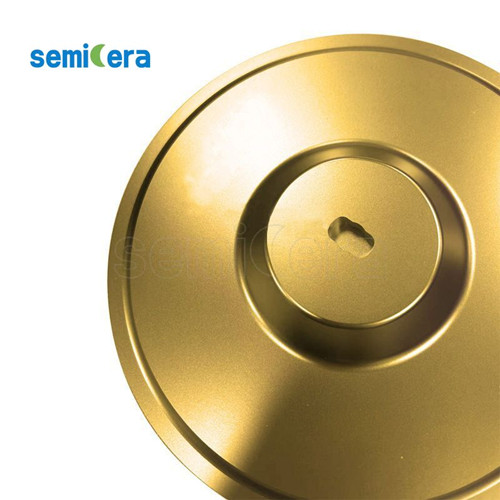
Tantalum carbide (TaC) coating is a high-performance ceramic surface treatment developed to meet the demanding requirements of extreme environments—particularly those involving elevated temperatures, corrosive atmospheres, and mechanical wear. Characterized by its exceptional hardness, chemical stability, and thermal resistance, TaC has found widespread use in industries such as semiconductor manufacturing, aerospace, high-temperature metallurgy, and nuclear technology. Unlike general-purpose coatings, TaC is typically reserved for scenarios where both structural integrity and surface purity are non-negotiable.
At the material level, TaC belongs to the class of ultra-high temperature ceramics (UHTCs), with a melting point exceeding 3800°C and Vickers hardness well over 2000 HV. It exhibits a cubic crystal structure similar to other transition metal carbides, but offers superior chemical inertness, especially in halogenated or plasma environments. These properties enable TaC coatings to function as robust barriers against corrosive attack, oxidation, and thermal degradation. For components such as graphite parts in semiconductor etch chambers or susceptors in epitaxy reactors, this translates to significant gains in lifespan and process reliability.
The application of TaC coatings is typically achieved through methods such as chemical vapor deposition (CVD) or physical vapor deposition (PVD), which allow for fine control over coating thickness, microstructure, and adhesion to the substrate. However, achieving effective protection is not simply a matter of deposition. The mismatch in thermal expansion coefficients between the ceramic layer and the underlying material, especially when the substrate is carbon-based, requires precise engineering of the interfacial bonding to mitigate stress accumulation during thermal cycling. Otherwise, issues like microcracking or delamination may arise, especially in high-frequency or rapid heat-up processes.
In practice, a high-quality TaC coating is not only defined by its hardness or uniformity but also by its density and defect control. A dense, pore-free surface is crucial to preventing reactive species from penetrating and attacking the substrate. Furthermore, in plasma-intensive applications or ultra-clean manufacturing environments, the coating’s resistance to particle generation is of equal importance. Flaking, powdering, or erosion of the coating surface could directly impact product yield, particularly in semiconductor fabrication where even nanoscale contamination can compromise device performance.
One of the key advantages of TaC over conventional coatings, such as alumina or silica-based ceramics, lies in its stability at high temperatures in chemically active environments. For example, in chlorine- or fluorine-rich plasma processes, alumina coatings may degrade or form volatile compounds, while TaC maintains its structural and chemical integrity. This makes it a preferred choice for inner liners, heat shields, and load-bearing components subjected to both mechanical and chemical loads.
Despite its benefits, TaC coatings require careful consideration in terms of design and process compatibility. Their high deposition temperatures may limit use on certain substrates, and the relatively brittle nature of the ceramic necessitates optimized geometries to avoid stress concentrations. Moreover, cost factors also come into play—due to the complexity of the coating process and the raw material’s scarcity, TaC coatings are generally reserved for mission-critical components where failure is unacceptable.
In summary, Tantalum Carbide Coating serves as a technologically advanced protective layer tailored for severe environments. It is not a universal solution, but rather a precision-engineered defense mechanism deployed where conventional materials fail—transforming vulnerable surfaces into high-performance interfaces capable of withstanding the extremes of modern industry.
Post time: Dec-19-2025