Custom Parts
WHY CUSTOM
Every reactor is different
Thermal field geometry, wafer size, gas chemistry, and duty cycle vary from one production line to the next — which means the parts that go inside rarely come off a shelf.
Most of what we build for customers isn't a catalog item. It's built against a drawing, a thermal field simulation, or a sample of the part that's currently failing on their line. This page is a picture of the materials, processes, and precision control that let us take a requirement from spec sheet to qualified part.
MATERIALS & PROCESSES
What we work in
Coating, machining, and raw-material synthesis all happen in-house. Nothing is handed off between vendors — which is usually where dimensional tolerance and purity control get lost on complex geometries.
- ● High-purity graphite — machined to customer geometry as a coating substrate, or supplied as a finished component on its own.
- ● CVD SiC coating — chemical inertness and thermal stability up to the practical SiC temperature ceiling.
- ● CVD TaC coating — for higher-temperature, high-purity applications such as SiC PVT crystal growth.
- ● CVD PyC coating — used as a diffusion barrier or intermediate layer in multilayer coating structures.
- ● High-purity SiC source powder — synthesized and purity-graded up to 6N as source material for PVT crystal growth.
CAPABILITY IN PRACTICE
What we've built to spec
A sample of the range — not an exhaustive list. Most orders start from a drawing, not a part number.
|
Category |
Example |
|
Source materials |
High-purity SiC powder graded to a customer's target resistivity and defect density for PVT growth |
|
Wafer carriers |
SiC-coated graphite wafer boats — square, round, multi-slot, and custom geometries for diffusion, oxidation, and epitaxy furnaces |
|
Heating elements |
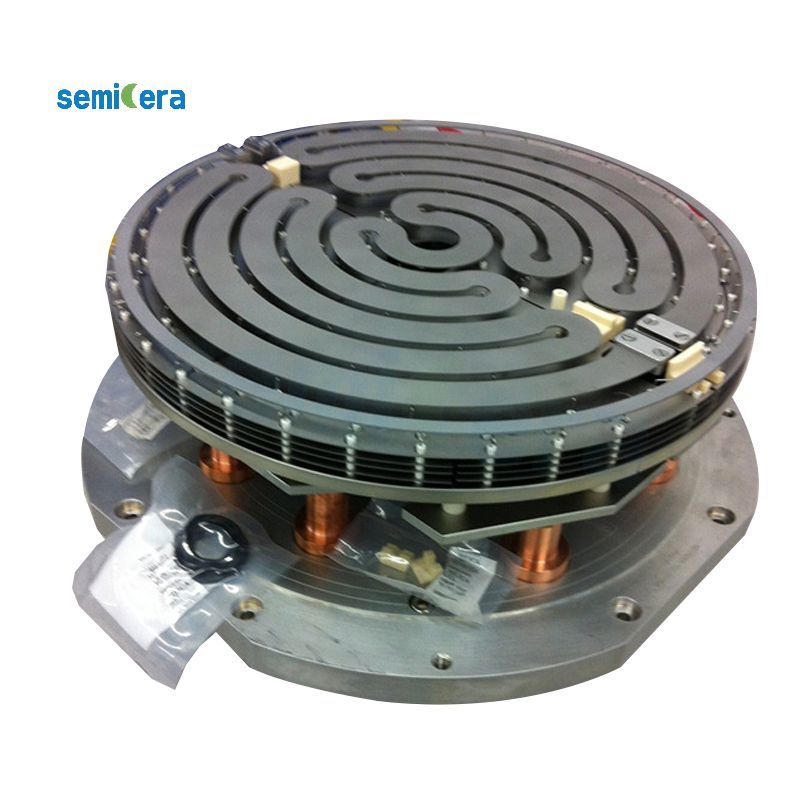
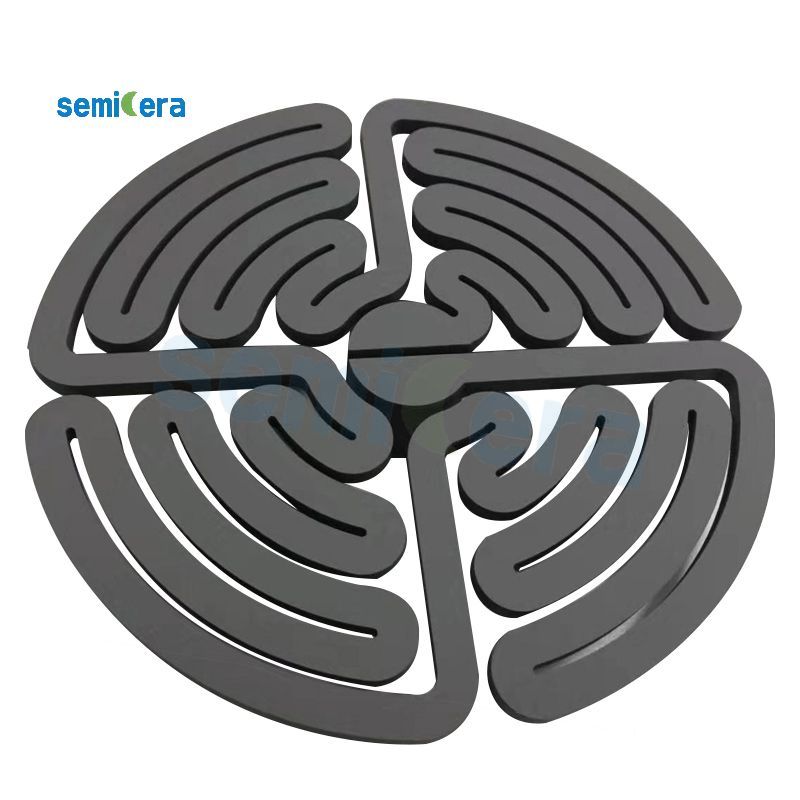
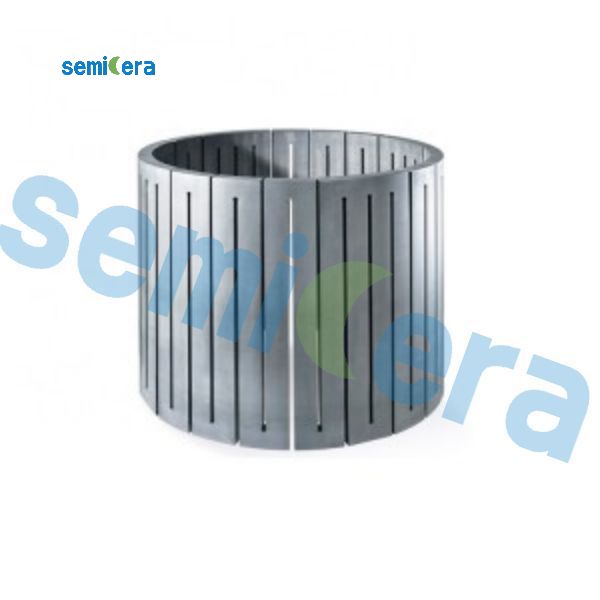
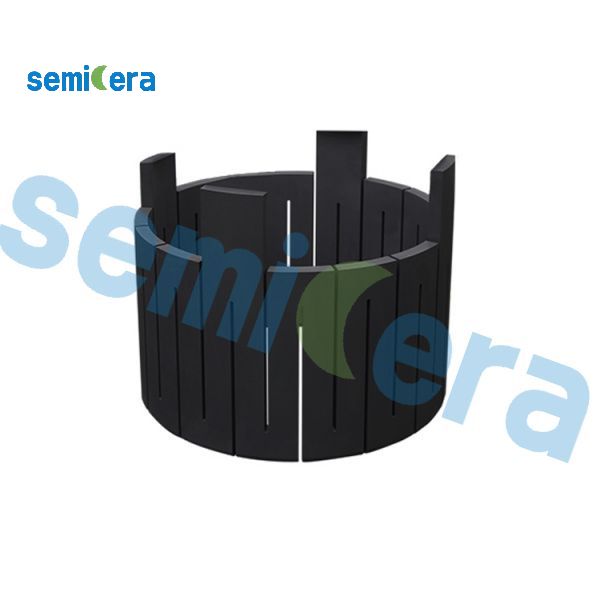
Graphite and SiC-coated heaters with circuit patterns engineered for a specific reactor's radial uniformity target |
|
Crystal-growth parts |
TaC- and SiC-coated crucibles and hot-zone components for PVT and CVD crystal growth setups |
QUALITY SYSTEM
Precision & traceability
- ● Batch purity reports — GDMS / ICP-MS analysis on source materials and coated parts, issued per batch.
- ● Thickness & dimensional control — eddy-current scanning and cross-section verification, with particular attention at edges and corners, where coating thickness variation drives most early failures.
- ● Built to your spec — parts machined and coated against a customer drawing or thermal field simulation, not fixed tooling.
- ● Full traceability — every batch carries a trace code linking incoming inspection, installation records, and field monitoring data back to the original spec.
This is the same engineering discipline behind our published guidance on coating selection and lifecycle management — purity and uniformity control aren't a marketing claim here, they're the same checklist we hand customers for incoming inspection on the parts we build for them.
PROCESS
How a custom order works
- ● 1. Share the requirement — a drawing, a thermal field simulation, a failed part, or a process condition the current part isn't surviving.
- ● 2. Get a recommendation — material, coating, and geometry proposal, including trade-offs, built on the atmosphere-first decision framework we use across our own hot-zone parts.
- ● 3. Qualify a sample — a first-article sample with full purity and dimensional documentation, so incoming inspection can be done against real data.
- ● 4. Order in batch, with traceability — each batch ships with its own purity report and trace code, extendable to field monitoring through our lifecycle data service.
Send a drawing, a spec, or a part that's failing — we'll tell you what we can build and how fast.