
1. Introduction
In modern semiconductor manufacturing, high-temperature thermal processing steps (such as diffusion and oxidation) remain fundamental to device fabrication. These processes are typically conducted at temperatures ranging from 900 °C to over 1200 °C and are often performed in reactive atmospheres containing gases such as oxygen, hydrogen, and halogens. Under such conditions, the selection of materials for furnace components—particularly furnace tubes—plays a critical role in process stability, contamination control, and overall yield.
Traditionally, quartz (fused quartz) furnace tubes have been widely used due to their high purity and cost-effectiveness. However, as device dimensions shrink and process requirements become increasingly stringent, the limitations of quartz—such as susceptibility to deformation at high temperatures and chemical erosion—have become increasingly apparent.
Silicon carbide (SiC) furnace tubes have emerged as a reliable alternative, particularly for advanced and high-temperature applications. Their adoption is primarily driven by their superior thermal, mechanical, and chemical properties, which directly translate to enhanced process performance and lower long-term ownership costs.
2. What Are Silicon Carbide Furnace Tubes?
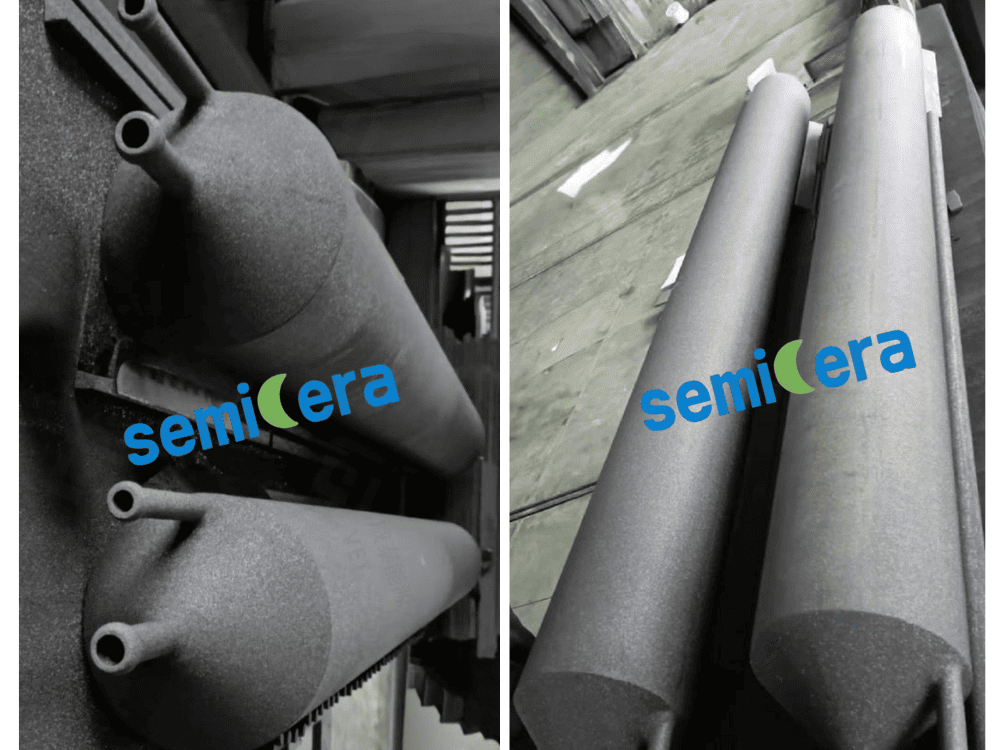
Silicon carbide furnace tubes are high-performance process tubes made from silicon carbide. Silicon carbide is a ceramic material renowned for its exceptional thermal stability, high mechanical strength, and chemical inertness. It exists in various forms within semiconductor equipment, including recrystallized silicon carbide (RSiC) and chemical vapor deposition silicon carbide (CVD SiC), each with varying degrees of purity and density.
Compared to amorphous silicon dioxide (SiO₂) quartz, silicon carbide is a crystalline compound with higher thermal conductivity and mechanical stiffness. These inherent material differences result in distinctly different performance characteristics in high-temperature furnace environments.
Silicon carbide furnace tubes are commonly used in diffusion furnaces, oxidation furnaces, and certain chemical vapor deposition (CVD) systems. The use of silicon carbide furnace tubes is particularly advantageous in processes requiring sustained high temperatures, rapid thermal cycling, or exposure to chemically corrosive gases.
3. Top 5 Advantages of SiC Furnace Tubes
The increasing adoption of SiC furnace tubes in semiconductor fabs is largely attributed to five key performance advantages, each of which addresses critical limitations of conventional quartz systems.
First, SiC offers superior high-temperature stability. Silicon carbide maintains structural integrity at temperatures well above 1400 °C, whereas quartz begins to soften at approximately 1200 °C and can exhibit viscous deformation over time①. This high-temperature capability enables more stable process conditions and reduces the risk of tube sagging, which can otherwise lead to non-uniform wafer spacing and temperature gradients.
Second, SiC demonstrates excellent chemical resistance in aggressive process environments. It is highly resistant to oxidation and exhibits strong corrosion resistance against halogen-based gases such as HCl and Cl₂, which are commonly used in diffusion and cleaning processes. In contrast, quartz can undergo surface reactions and devitrification under prolonged exposure to such environments②. This improved chemical durability directly contributes to reduced contamination risks and enhanced process repeatability.
Third, SiC furnace tubes provide a significantly longer service lifetime. Due to their high mechanical strength and resistance to thermal shock, SiC components can withstand repeated thermal cycling with minimal degradation. Studies and industry reports indicate that SiC furnace tubes can achieve service lifetimes several times longer than quartz under comparable operating conditions, depending on process parameters③. This extended lifetime reduces equipment downtime and maintenance frequency, which are critical cost drivers in high-volume manufacturing.
Fourth, SiC offers substantially higher thermal conductivity compared to quartz. The thermal conductivity of silicon carbide typically ranges from 120 to 200 W/m·K, whereas fused silica is approximately 1.4 W/m·K at room temperature④. This difference of nearly two orders of magnitude enables more efficient heat transfer, resulting in improved temperature uniformity and faster thermal ramp rates. For diffusion and oxidation processes, this translates into tighter process control and improved wafer-to-wafer consistency.
Finally, SiC contributes to reduced particle generation and contamination. Its dense and mechanically robust structure minimizes the formation of microcracks and surface degradation, which are common sources of particle contamination in quartz tubes after prolonged use. In advanced semiconductor nodes, where defect density directly impacts yield, this advantage becomes increasingly critical.
4. SiC vs Quartz Furnace Tubes
When comparing SiC and quartz furnace tubes, the distinction extends beyond material properties to overall process performance and cost implications.
Quartz remains a cost-effective solution for lower-temperature processes and applications with less stringent durability requirements. Its high purity and optical transparency are advantageous in certain use cases. However, its relatively low softening point (~1200 °C) and poor thermal conductivity limit its performance in advanced thermal processes.
In contrast, SiC furnace tubes offer superior thermal stability, mechanical strength, and chemical resistance, making them more suitable for high-temperature and high-throughput environments. While the initial cost of SiC components is higher, their extended service life and reduced maintenance requirements often result in a lower total cost of ownership (TCO) over the lifecycle of the equipment.
This trade-off between upfront cost and long-term performance is a key consideration for fabs evaluating material upgrades.
5. Application Examples
Silicon carbide (SiC) furnace tubes are widely used in applications where process conditions exceed the practical limits of quartz or where higher reliability is required.
In diffusion processes, particularly phosphorus and boron diffusion processes, SiC furnace tubes provide a stable thermal environment and resist corrosion from dopant gases. In thermal oxidation processes, both dry and wet oxidation methods benefit from the improved temperature uniformity resulting from SiC’s high thermal conductivity.
Furthermore, SiC furnace tubes are increasingly used in the manufacturing of power semiconductor devices, including silicon carbide (SiC) and gallium nitride (GaN) devices, where process temperatures are typically high and material compatibility is critical.
The application of SiC furnace tubes is also expanding in advanced logic and memory manufacturing, where process windows and defect tolerances are more stringent, necessitating more robust and durable furnace tube materials.
6. Is SiC Suitable for Your Process?
Determining whether SiC furnace tubes are suitable for a specific process requires a careful evaluation of operating conditions, cost constraints, and performance requirements.
Due to the limited thermal stability of quartz tubes, processes operating at temperatures above 1000 °C—especially those approaching or exceeding 1100–1200 °C—are ideal candidates for silicon carbide (SiC). Similarly, processes involving corrosive gases or frequent thermal cycling can greatly benefit from SiC’s chemical and mechanical stability.
From a cost perspective, wafer fabs that experience frequent quartz tube replacements, unplanned downtime, or yield losses due to contamination should consider the long-term economic advantages of SiC. Ultimately, SiC furnace tubes should not be viewed merely as a material substitute, but rather as a strategic upgrade designed to enhance process stability, improve yield, and optimize the total cost of ownership in advanced semiconductor manufacturing environments.
Reference:
①Source:Corning Fused Silica Technical Data; ASM Handbook, Volume 4: Heat Treating
②Source:“Materials Science of Ceramics,” Barsoum, 2019; ASTM C799
③Source: GT Advanced Technologies application notes; CoorsTek technical ceramics data
④Source: ASM Handbook; MatWeb Material Property Database
Post time: Apr-10-2026