
In the rapidly evolving semiconductor industry—driven by the surge in wide-band gap (WBG) power devices, 5G RF communications, and advanced optoelectronics —achieving ultra-high purity and precise atomic-layer uniformity during crystal growth is paramount. At Semicera, we specialize in high-performance thermal field components that power these critical processes.
One of the most essential consumables in modern Chemical Vapor Deposition (CVD) and Metal-Organic Chemical Vapor Deposition (MOCVD) systems is the Silicon Carbide (SiC) Coated Graphite Susceptor. But what exactly is it, why is the SiC coating indispensable, and how does it determine epitaxial wafer yield?
The Role of the Susceptor in Epitaxial Deposition
To understand the SiC coated graphite susceptor, we must first look at the epitaxial growth process. Advanced device fabrication requires growing high-purity single-crystal thin films onto raw wafer substrates:
GaN-on-Si/GaN-on-SiC: Used for high-frequency Radio Frequency (RF) components (like HEMTs) and power electronics.
SiC-on-SiC Epitaxy: Essential for high-voltage power devices such as Schottky Barrier Diodes (SBDs) and MOSFETs used in electric vehicles (EVs) and energy grids.
III-V Optoelectronics: Deposition of GaAs or InP layers for high-brightness LEDs and laser diodes.
During CVD/MOCVD growth, precursor gases (containing Group III/V or Group IV elements) are introduced into a vacuum chamber at temperatures exceeding 1,000°C. Raw wafers cannot sit directly on bare metal heating elements due to chemical reactivity, thermal deformation, and extreme risk of metallic contamination.
Instead, wafers are mounted into precision-machined pockets on a susceptor (also referred to as a wafer carrier or tray). The susceptor performs two vital functions simultaneously:
Physical Support & Flow Dynamics: It securely holds wafers in specific horizontal, vertical, or planetary rotation patterns to optimize gas-flow boundary layers.
Thermal Induction & Uniformity: It acts as the primary heat exchanger, transferring uniform thermal energy directly to the wafer substrate.
Why Pure Graphite Needs a CVD SiC Shield
Isostatic graphite is an ideal core material for susceptors because of its excellent thermal conductivity, resistance to thermal shock, low thermal mass, and high mechanical machinability. However, bare graphite presents severe limitations in semiconductor-grade epitaxy:
Chemical Corrosion & Powdering: At elevated temperatures, aggressive gases such as Hydrogen (H2), Ammonia (NH3), and Hydrochloric Acid (HCI) react with carbon, eroding the graphite matrix and causing fine graphite dust to shed.
Particulate Contamination: Floating graphite particles land on the spinning wafer surface, causing severe lattice defects, pinholes, and layer non-uniformity.
Outgassing & Impurities: Unsealed porous graphite absorbs ambient moisture and volatile gases, which slowly outgas during processing and compromise epi-layer purity.
To eliminate these vulnerabilities, Semicera applies a dense, continuous Silicon Carbide (SiC) coating over the ultra-pure graphite core via Chemical Vapor Deposition (CVD).
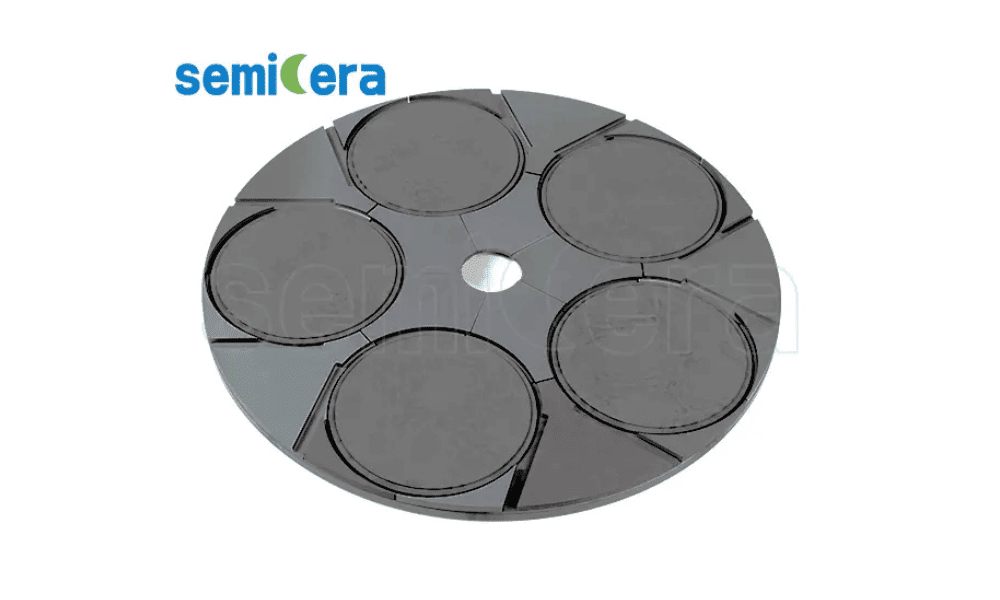
Key Performance Characteristics of Semicera SiC Coated Susceptors
A semiconductor-grade SiC coated graphite susceptor must meet stringent chemical, thermal, and structural parameters to survive harsh processing environments:
1. Superior Hermetic Encapsulation
The CVD SiC coating provides a 100% pinhole-free barrier surrounding the graphite core. This complete seal prevents reactive gas attack and blocks volatile impurities from diffusing out of the graphite substrate.
2. Tailored Coefficient of Thermal Expansion (CTE) Matching
Thermal fatigue causes coating delamination or micro-cracking during rapid temperature cycling (e.g., heating up to 1,500°C and cooling down repeatedly). At Semicera, we carefully select high-density graphite grades with an isotropic CTE (≈ 4.5-5.0 X 10⁻⁶/K) that closely matches pure B-SiC (≈ 4.5-4.8 X 10⁻⁶/K), ensuring strong coating adhesion and extended service life.
3. Precision Surface Flatness & Mirror Finish
Thin-film uniformity depends on absolute wafer-to-susceptor contact and thermal radiation consistency. The coating must maintain the precision-machined micro-pockets’ geometry with surface roughness down to sub-micron tolerances.
4. Extreme Chemical & Thermal Resistance
SiC exhibits exceptional resistance to chemical etching from chlorine- and fluorine-based cleaning gases (e.g., HCl, NF3) and maintains high mechanical strength up to 1,600°C. (Note:For ultra-high temperature applications exceeding 2,000°C, Semicera also provides Tantalum Carbide (TaC) coated solutions).
Why Choose Semicera for Your CVD/MOCVD Thermal Field?
At Semicera, we understand that epitaxial wafer yield directly impacts your bottom line. Our SiC coated graphite susceptors feature:
Custom Engineering: Tailored pocket geometries for single-wafer or multi-wafer planetary MOCVD platforms (AIXTRON, Veeco, LPE, Toyo Tanso-compatible systems).
Extended Service Life: Enhanced erosion resistance means fewer maintenance cycles and higher furnace uptime.
Strict Quality Control: Every susceptor undergoes 100% CMM dimensional checks, eddy-current coating thickness verification, and glow discharge mass spectrometry (GDMS) purity analysis.
Whether you are scaling up 6-inch/8-inch SiC epi-wafer production or optimizing GaN LED manufacturing, Semicera’s engineered graphite components deliver the purity, thermal uniformity, and durability your process demands.
Need Custom SiC/TaC Coated Graphite Solutions?
Contact Semicera’s engineering team today to request technical drawings, discuss custom pocket design, or receive a fast quote:
Phone/WhatsAPP: 86-13373889683
Email: sales01 @semi-cera.com
Website: www.semi-cera.com
Post time: Aug-14-2026