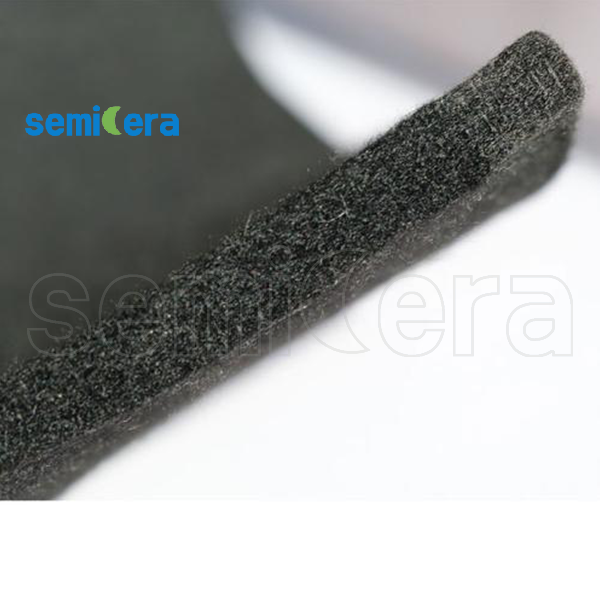
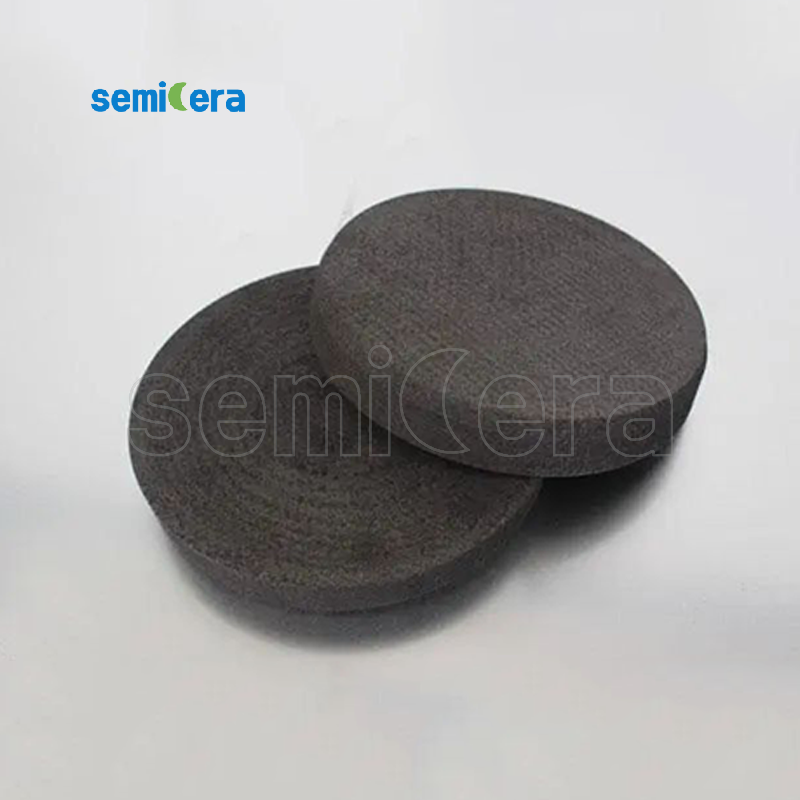
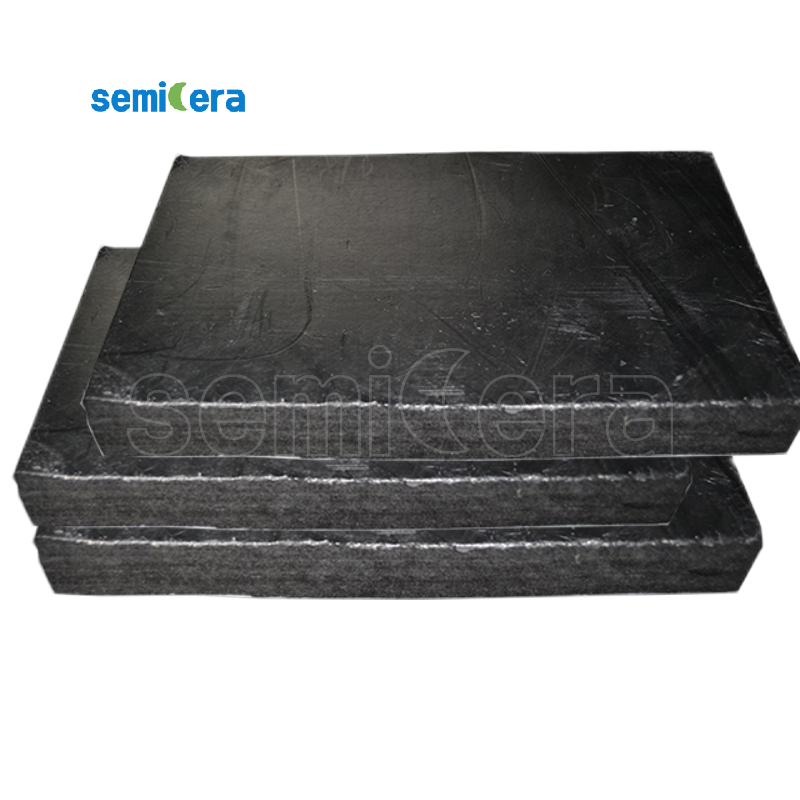
Hard Felt
Hard Felt is a rigid thermal insulation material fabricated from high-purity polyacrylonitrile (PAN)-based or viscose-based carbon fibers, processed through pre-oxidation, carbonization, graphitization, and resin impregnation followed by compression molding. Compared to conventional soft graphite felts, hard felts form a rigid skeletal structure via resin curing, endowing them with superior mechanical strength, compressive strength, and dimensional stability. Under inert or vacuum atmospheres, they can withstand temperatures up to 3,000 °C over extended periods while maintaining a low thermal conductivity coefficient (<0.1 W/(m·K) @ 1000 °C) and low ash content. The Semicera hard felt product line encompasses flat-plate hard felts, hard felt crucibles, pyrolytic carbon (PyC)-coated hard felt rings, and graphite composite carbon fiber felts.
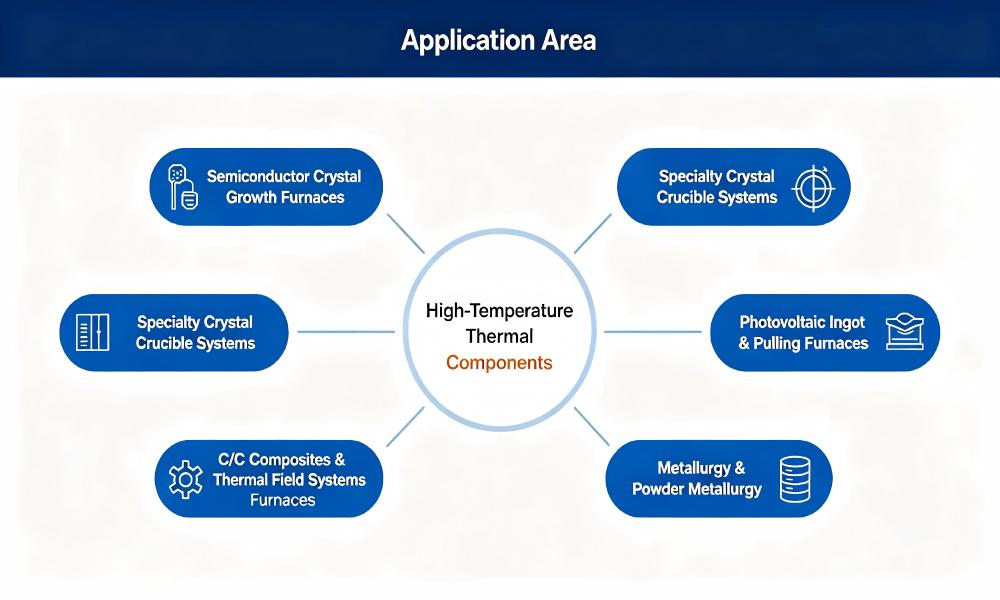
These materials are widely employed as insulation layers, structural supports, and sealing components in high-temperature equipment—including single-crystal and polycrystal silicon growth furnaces, sapphire crystal growth furnaces, photovoltaic ingot furnaces, vacuum sintering furnaces, and graphitization furnaces—making them critical consumables in high-temperature process applications across the semiconductor, photovoltaic, and carbon/carbon composite industries.
Product Technical Specifications
|
Product name |
Density reference range |
Maximum operating temperature (inert atmosphere) |
Ash content |
Process Characteristics / Typical Applications |
|
0.18–0.22 g/cm³ |
≤3000℃ |
≤0.2% |
Manufactured via compression molding, this material exhibits excellent dimensional stability, a low thermal conductivity coefficient (<0.1 W/(m·K) at 1000 °C), and is used as an insulation layer in vacuum furnaces, sintering furnaces, and single-crystal furnaces. |
|
|
0.25–0.45 g/cm³ |
≤3000℃ |
≤0.3% |
Integrally formed / seamless structure, featuring excellent thermal shock resistance and higher mechanical strength than conventional soft felt; suitable for supporting crucibles in the growth of single-crystal silicon, sapphire, and other crystals. |
|
|
0.18–0.22 g/cm³ (matrix) |
≤3000℃ |
≤0.1% |
The surface PyC (pyrolytic carbon) coating seals the fiber pores, significantly enhancing gas tightness and oxidation resistance, while reducing impurity release; it is suitable for use in furnace sealing rings and gas flow dividers. |
|
|
0.20–0.35 g/cm³ |
≤3000℃ |
≤0.2% |
The composite material, consisting of a carbon fiber-reinforced layer and a graphite felt, exhibits higher mechanical and compressive strengths, making it suitable for high-load, high-strength thermal insulation structural components. |
Core Performance Advantages
- High-temperature resistance: The maximum operating temperature under inert or vacuum atmospheres reaches 3,000 °C, with no softening or melting observed during prolonged stable operation.
- Low thermal conductivity and high thermal insulation efficiency: The porous fiber structure reduces heat conduction, effectively minimizing heat loss from the high-temperature furnace body, thereby delivering significant energy-saving benefits.
- High mechanical strength and rigidity: The resin-cured skeleton structure endows the hard felt with superior compressive and flexural strengths compared to soft felt, enabling it to withstand specific structural loads.
- Low ash content and high purity: Ash content as low as 0.1%–0.3%, reducing impurity contamination during high-temperature processes and meeting semiconductor-grade cleanliness requirements.
- Excellent machinability: enables machining operations such as turning, milling, and drilling according to technical drawings, allowing the fabrication of custom-shaped components, including crucibles and annular seals.
- Excellent chemical stability: resistant to acid and base corrosion, and exhibits stable performance in reducing atmospheres as well as in most chemical media.
Application area
- End-to-end quality control: key parameters—including ash content, density, thermal conductivity, and purity—can be supported by third-party test reports.
- Support for non-standard customized processing: dimensions, thickness, density grade, and shape (crucibles, rings, custom-shaped parts) can all be customized according to technical drawings.
- Stable supply capability: Standardized production processes ensure batch consistency, supporting both regular and urgent deliveries.
- Technical Support: Our engineering team can provide equipment selection recommendations and technical solutions tailored to specific furnace types and process temperatures.
FAQ
Q: What are the differences between rigid graphite felt and standard soft graphite felt?
A: The soft graphite felt, uncured with resin, is flexible and foldable, making it suitable for wrapping irregularly shaped furnace walls; the hard felt, after being resin-impregnated, molded, and cured, forms a rigid skeleton, offering higher mechanical strength and dimensional stability. It can be directly processed into structural components such as crucibles and ring-shaped parts, making it more suitable for applications requiring load-bearing capacity or precise dimensional fit.
Q: What is the maximum operating temperature of graphite hard felt? Can it be used in air?
A: In an inert gas atmosphere (nitrogen, argon) or under vacuum conditions, the maximum operating temperature of hard felt can reach approximately 3,000 °C; however, in an oxidizing atmosphere (e.g., air), graphite materials undergo oxidative ablation above 400–450 °C. Consequently, hard felt is primarily employed inside sealed high-temperature equipment, such as vacuum furnaces and inert-atmosphere furnaces.
Q: For which crystal growth processes are hard felt crucibles suitable? Can they replace graphite crucibles?
A: Hard felt crucibles are commonly used in crystal growth furnaces for single-crystal silicon, polycrystalline silicon, and sapphire, serving as thermal insulation structural components or crucible supports, offering both lightweight properties and excellent thermal insulation performance. Compared to pure graphite crucibles, hard felt crucibles are lighter in weight and exhibit superior thermal insulation performance; however, their compressive strength and wear resistance are generally lower than those of solid graphite crucibles. The two types of crucibles can be used in combination depending on process requirements. For specific selection, it is recommended to consult technical engineers based on the furnace type and thermal field design.
Q: What is the function of the pyrolytic carbon (PyC) coated hard felt ring?
A: The pyrolytic carbon coating is formed on the surface of a hard felt substrate via a chemical vapor deposition (CVD) process, creating a dense carbon layer that seals the inter-fiber pores. This process significantly enhances the material's gas tightness and oxidation resistance, while reducing the release of particles and impurities during operation. It is commonly employed in components—such as furnace sealing rings and gas flow partitions—that require high purity of the ambient atmosphere.
Q: What are the advantages of graphite composite carbon fiber felts compared to conventional graphite hard felts?
A: By incorporating a carbon fiber reinforcement layer into a rigid felt matrix, the graphite-carbon fiber composite felt further enhances the material's compressive strength, flexural strength, and impact toughness. This makes it suitable for thermal insulation components subjected to higher structural loads or vibrational conditions, thereby improving structural reliability while maintaining excellent thermal insulation performance.
Contact us
If you require detailed technical specifications (Datasheets), test reports, or customized solutions for our hard felt products, please feel free to request a quote or contact our team of technical engineers.